

CLT History
Community Land Trusts (CLTs) are a product of the Civil Rights Movement in the United States in the 1960’s. The first CLT, New Communities, Inc., was formed in 1969 in Albany, Georgia as a homestead and farming cooperative by Black civil rights activists in response to the lack of affordable housing and economic opportunities in their community. Slater King, a leader of the Albany Movement who fought ardently for desegregation, and Charles Sherrod, a community organizer for the Student Nonviolent Coordinating Committee, were instrumental in establishing New Communities. They understood the pervasive cycle of economic and community harm that segregation caused to Black communities. Black community members in Georgia, and across the Deep South, were subject to rampant discrimination and stifled economic opportunity but could lose their jobs, their homes, and face jail time or worse if they protested against segregation. It became clear to Sherrod and King that ownership of their own land was a key to Black community members gaining the independence and security to continue standing up to segregation. After receiving a grant from the National Sharecroppers Fund, fundraising, and securing debt capital, New Communities was able to purchase a 5,700-acre tract of land in Leesburg, Georgia.
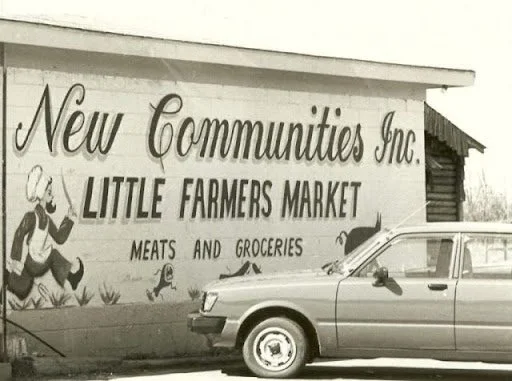
Unfortunately, due to onerous debt obligations, drought conditions, obstruction from the segregationist governor of Georgia, and racial bias against Black farmers from the Farmers Home Administration, New Communities was forced to sell a portion of their land in the early 1980s and eventually lost the entire property to foreclosure in 1985. However, New Communities, Inc. persevered as an organization as leaders like Shirley Sherrod, wife of Charles Sherrod, continued to meet and promote community action. In 1999, Black farmers won a $375 million settlement from the US Department of Agriculture for the Farmers Home Administration's discriminatory lending. It took another decade of persistence but in 2009 New Communities, Inc. was awarded a $12 million payout as part of the settlement. In 2011, that money was reinvested to purchase a 1600-acre former plantation that would now be used for the benefit of the community.
Bob Swann, a homebuilder who had come to Georgia to help rebuild churches that had been firebombed in racist attacks, was another instrumental figure in the founding of New Communities. Swann became friends with Clarence Jordan who founded Koinonia Farms which would eventually evolve into Habitat for Humanity. Slater King also regularly visited Koinonia Farms and likely met Swann there. Swann and King worked helped develop the initial leasehold model paired with community ownership that has become central to CLTs today. Since the 1960s, as both the CLT model and the Habitat for Humanity model have grown, they have been used to great effect to provide wealth-building opportunities for households excluded from the traditional housing market. Increasingly, in recent decades, the two models have become more interconnected as Habitats around the country have been turning to CLTs in order to preserve affordability and stretch subsidy dollars farther.
Sources
“The First CLT: for & by Black Farmers.” Sectclt.org. https://sectclt.org/the-first-clt-for-by-black-farmers
“Seeding the First CLTs: New Communities Inc.” (October 17, 2013). ROOTS & BRANCHES. https://cltroots.org/the-guide/early-hybrids-breeding-and-seeding-the-clt-model/georgia-seedbed